Physical AI
Microduck sold 10,000 units in five days
Hugging Face and Pollen Robotics opened Microduck pre-orders on August 27 — a $399 biped with local RL policies. What that price says about Physical AI supply chains.
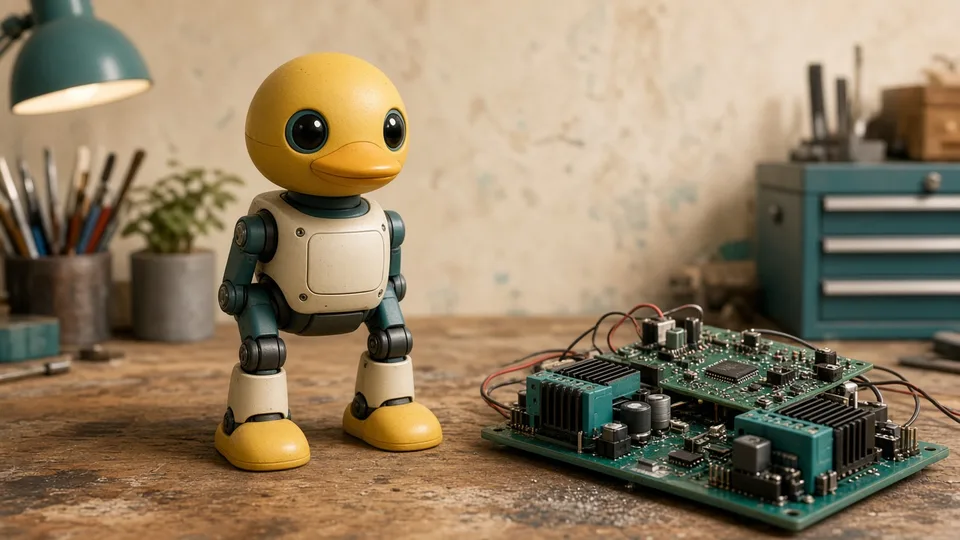
On August 27, Pollen Robotics — now part of Hugging Face — opened pre-orders for Microduck, a 25 cm biped robot duck at $399. CEO Clem Delangue said on X that pre-orders passed 10,000 units within five days. Six hours after launch, order value crossed $1 million.
This is not a desk toy with a chat API. Fifteen motors, a front camera, 8×8 time-of-flight LiDAR, dual IMUs, and a Rockchip RK3566 running a 50 Hz control loop. Seven behaviors ship trained: walk, sit, kick, scoop, roller-skate, and stand up after a fall. The software stack and MuJoCo → PPO → sim2real pipeline are open. The mechanical design is not.
Why the number is the story
At $399, Microduck is priced like a premium consumer gadget, not a lab manipulator. The bill of materials still includes real sensing and onboard inference. Pollen's earlier Reachy Mini — also $399 — reportedly crossed 10,000 units with Seeed Studio in Shenzhen handling mechanical, electrical, and production coordination.
Microduck's label of origin is China. EU and US fulfillment uses regional warehouses, but the economics are Greater Bay Area supply chain economics: CNC frames, battery packs, speakers, and PCBA from vendors that already build millions of connected devices.
Physical AI teams are learning what phone OEMs learned a decade ago: commodity motion and sensing + differentiated software beats bespoke mechatronics on the first SKU.
What builders can copy
- Train policies in simulation; deploy ONNX on device — same rhythm as edge ML on a custom board.
- Keep the brain in Rust daemons with explicit RPC, not one opaque binary.
- Treat open software on closed mechanics as a go-to-market choice, not a moral defect.
If you are designing your own articulated product, Microduck is a reference point for what buyers now expect at a sub-$500 price: cameras, ranging, and behaviors out of the box, with a path to retrain.
From duck to your BOM
Selling 10,000 ducks does not make your PCB easier. It raises the bar for first articles: your board has to survive the same cost consciousness and the same lead-time pressure.
We assemble connected products — PCBA, optional STEP enclosures, box-build — on one program from intake through volume. When your agent changes a placement file, Gate preflights the set before you commit to copper. That is the loop embodied AI teams still need once the demo leaves the lab.
Jensen Huang reportedly kept Microducks on stage while talking physical AI. The duck is cute. The supply chain behind it is the lesson — and it is the same chain many Bay Area founders are flying to meet in person.